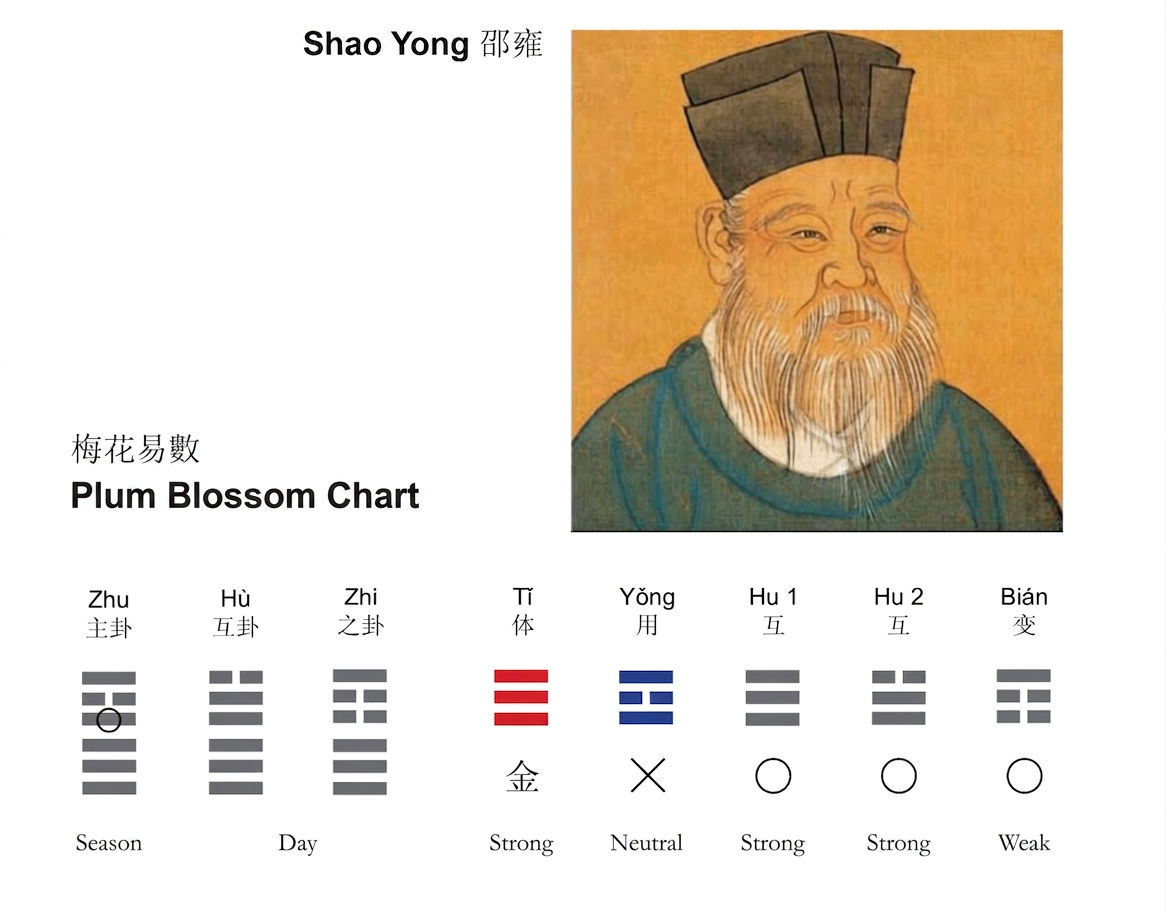
Mei Hu Yi Shu
Plum Blossom (Mei Hua Yi Shu) is one of the principal methods of I
Ching divination, based on the interpretation of the 64 hexagrams.
Its name comes from the plum blossom, which flowers at the end of winter and
signals the arrival of spring. It symbolises the ability to perceive subtle
signs and understand the messages that life continuously presents—guided by
both observation and intuition.
This approach combines intuitive insight with a solid foundation in Chinese
metaphysics. A hexagram is cast with a changing line, meaning
that one of its six lines transforms from Yin to Yang, or vice versa.
The interpretation arises from the original hexagram, the changing line, and
the resulting transformation—revealing the dynamics of a situation and its
likely development.
The Plum Blossom method is traditionally attributed to Shao Yong
(1011–1077), also known as Shao Kangjie, a renowned scholar of the Song
dynasty—a period of great cultural and philosophical development in China.
According to tradition, after a lifetime of study and contemplation, he
lived in Luoyang. It is said that at the moment of his death, he smiled and
remarked: “Life and death are the most common of things.”