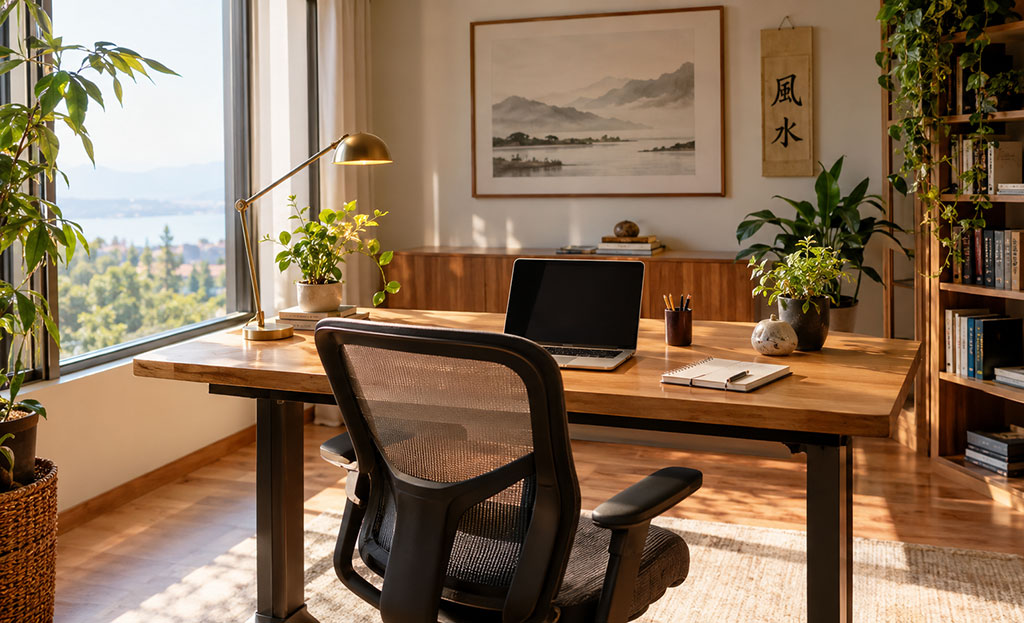
Feng Shui Home Office: Set Up Your Space for Success
This is the space where you make decisions, build projects, and shape your professional future. It deserves more than a nice chair.
Feeling stuck, scattered, or stalled at your desk might have nothing to do with your to-do list. You spend thousands of hours in your home office, yet you've probably never checked whether that space is actually working for you. In Traditional Feng Shui, small details like where your desk sits, what's behind your chair, and even where you keep the printer can shape your focus, your prosperity, and your leadership every single day.
The Desk: The One Decision That Shapes Everything Else
Before you think about colors or decor, look at your desk. In Traditional Feng Shui, it's the center of your entire professional life, and its position matters more than anything else in the room.
Find Your Command Position
The door is the main entry point for a room's Qi. Sit with your back to it, and you lose the command position, along with your sense of control and your ability to concentrate.
The fix: whenever you can, position your desk so you can see the door, without sitting directly in line with it.
Red Phoenix Ahead, Black Tortoise Behind
The space in front of your desk is the Red Phoenix (朱雀): your vision, your opportunities, your future. Facing a wall blocks that space symbolically, so look for an open outlook whenever possible.
Behind your chair, a solid wall is ideal. It represents the Black Tortoise (玄武): support, stability, protection. A high-backed chair reinforces the same energy, and in Traditional Chinese Medicine, it's linked to the Water element and your lower back.
• No wall behind you, just a window? A heavy curtain can partly compensate.
• Boxes or clutter piled up behind your chair weaken your "Tortoise" just as much as a missing wall does.
Windows, Beams, and Light
• Window position. Light refreshes your Qi, but placement matters. In front of you, a window can increase distractions; behind your chair, it reduces your sense of support. Aim to benefit from the light without losing your command position.
• The view outside. A garden, trees, or water inspire you more than walls, traffic, or buildings pressed too close.
• Beams over the desk. A beam directly above your workspace creates visual and energetic pressure, often linked to a heavier sense of responsibility and harder decisions. Don't work underneath one.
• Lighting. Too little light drains the Yang you need to concentrate; light that's too white or too intense tires your eyes. Favor natural light, balanced with soft artificial lighting.
The Shape of the Room Works With You Too
Before objects and decor, look at the shape of the office itself.
• Regular rooms without sharp notches or tight angles let Qi flow more clearly and evenly.
• Long corridors aimed straight at your desk speed Qi up too much. Avoid sitting directly on that axis, and soften the path if you can.
• Columns, furniture corners, and sharp edges pointed at you create cutting Qi. Move the desk, move the object, or soften the edge.
• What's next door counts too. Sound, vibration, and activity from the room beside you, or the floor above and below, can affect your workspace. Avoid setting up directly below a bathroom, for example.
Green Dragon and White Tiger at the Desk
Just like the bed in a bedroom, your desk has two symbolic sides that need to balance each other.
• Left side, Green Dragon (青龍): growth, initiative, creativity. Keep this side higher and more active, a plant, a lamp, or a stack of documents all work.
• Right side, White Tiger (白虎): organization, discipline, rigor. Keep this side stable, tidy, and slightly lower than the Dragon.
Professional success comes from that exact balance: a strong Dragon that drives growth, and an organized Tiger that turns ideas into results.
What Belongs On and Around Your Desk
• Organization first. A cluttered desk blocks the flow of Qi and your mental clarity. Keep only what you actually use.
• Books and a library. Unlike a bedroom, your office welcomes the Yang of knowledge. An organized library reinforces competence and growth.
• Plants. They revitalize Qi and balance a space full of screens and electronics. Choose healthy plants and place them according to your sector.
• Crystals. They can harmonize the Qi near your computer, but there's no universal crystal. The right one depends on your sector, the Five Transformations, and your Flying Stars chart.
• Diplomas and certifications. Display them in your recognition sector (it varies by orientation) to reinforce credibility.
• Safe and financial documents. These can benefit from a sector linked to star 6 (Metal element, authority, management, wealth consolidation), based on your Flying Stars chart.
• The printer. It's Fire-energy equipment, so place it where that energy works in your favor.
• A water feature. It can activate prosperity, but only in the right sector. Outside Period 9 or the right energy map, it can activate challenging energy instead.
The Structure of Your Desk Matters
• Size. A desk that's too small limits your workspace, and can symbolically shrink your capacity to grow. Aim for space that's proportional to your goals.
• Material. Wood symbolizes growth and creativity, generally the most favorable choice. Metal supports rigor and discipline. Glass looks elegant but offers less stability and support.
• The Ba Gua of the desk. You can map life areas onto the corners of your desk itself. A family photo in the upper right corner, for example, reinforces family support for your work.
Where Your Office Sits in the Home (or Business)
Your office's location within your home, or your building, comes from your Flying Stars chart. Sectors favored by stars like 9 Wang Qi (prosperity in Period 9) or 1 Sheng Qi (growth and opportunity) tend to work especially well for professional spaces.
This matters even more for whoever leads: the space where the most important decisions get made, whether that's a company, a professional office, or a home business, should sit in a strategic position on the energy map.
Whenever you can, keep your office separate from your bedroom's energy. Working is Yang, resting is Yin. If you work from home, look for a well-defined, independent space, so the Qi of work doesn't spread into the areas meant for rest.
Color follows the same sector-based logic. There's no single "correct" office color; as a space built for activity and focus, it tends to benefit from more Yang tones, but the right choice always depends on your sector and your Flying Stars chart, never on aesthetics alone.
Your Office Evolves Over Time
Working consistently in the same spot helps you build a stable energetic connection to your work. But Traditional Feng Shui doesn't stop at your home's fixed chart. It also tracks the Annual Flying Stars, which shift every year. Sometimes it's worth adjusting your workspace's location or orientation to keep up, rather than assuming a good position stays good forever.
The 7 Most Common Home Office Mistakes
1. Sitting with your back to the door, or facing a wall. You lose the command position and the Red Phoenix's field of vision.
2. No support behind your chair. An unprotected window or clutter behind you weakens the Black Tortoise.
3. Working under a beam. It creates constant pressure on your decisions and daily effort.
4. Ignoring the sector of your desk, safe, printer, or water feature. Each element activates different energy depending on where it sits.
5. Letting work Qi spill into the bedroom. This mixes the Yang energy of activity with the Yin energy of rest.
6. Ignoring cutting Qi, columns, or corridors aimed at your desk. Sharp edges and fast-moving Qi make your workspace less stable.
7. Only looking at the room itself. What's on the other side of the wall, or the floors above and below, can affect your space too.
Where Should You Start?
You can't always change the room or the structure of your space, but you can always start somewhere. Before making any changes, check these seven areas:
1. Your desk position. Can you see the door without sitting directly in line with it, with open space ahead and solid support behind?
2. The room's shape and Qi flow. Is it regular? Is there a long corridor, a tight angle, or a flow aimed straight at your desk?
3. What's above, behind, and around you. Any beam, column, sharp edge, or clutter pressing on your workspace?
4. Your relationship with neighboring spaces. What sits on the other side of your walls, and on the floors above and below your desk?
5. The Dragon-Tiger balance. Is your left side active, and your right side organized?
6. Your sector in the home or office. Have you checked your Flying Stars chart for your desk, safe, printer, or water feature placement?
7. The separation between work and rest. Is your office's Qi clearly separated from where you sleep?
These seven checkpoints won't replace a full energy map analysis, but they're a solid starting point for spotting where your office might be holding you back instead of driving you forward.
Is Your Office Working in Your Favor?
The most important decisions of your professional life happen in this space. And yet it's probably the least analyzed room in your home, or your office.
No workspace hits every one of these principles right away, and Traditional Feng Shui doesn't ask for that. The goal isn't a "perfect" office. It's a space that increasingly supports what you're trying to build there: focus, creativity, leadership, and prosperity.
So, is your office really working in your favor? If you don't yet know the energy map of your home or workspace, now's a good time to find out.
FAQ: Feng Shui Home Office
What is the command position in feng shui?
It's the desk position that lets you see your office door without sitting directly in line with it, and ideally with a solid wall behind you. It gives you the strongest sense of control, safety, and focus while you work.
Which direction should my desk face in a home office?
There's no single direction that works for everyone. The right orientation depends on your personal energy map and your home's Flying Stars chart, but your desk should always let you see the door without sitting with your back to it.
Can I fix a home office that has no wall behind my desk?
Yes. A heavy curtain, a tall bookshelf, or a solid piece of furniture placed behind your chair can partly substitute for a wall and help rebuild your sense of support.
Do plants really help a home office's feng shui?
Yes. Plants revitalize Qi and help balance a space filled with screens and electronics, especially useful in a home office. Choose healthy, well-maintained plants and place them according to your sector.
Should my home office and bedroom share the same space?
It's best to keep them separate whenever possible. Work carries Yang energy and rest carries Yin energy, and mixing the two can affect both your sleep and your focus.
Ready to go deeper? Get in touch and schedule your Traditional Feng Shui consultation with Feng Shui Academy.
Feng Shui Academy: Traditional Feng Shui Teaching & Consulting