Kitchens in Feng Shui: The Real Rules Behind the Myths
From the stove to the knives on the counter, every detail of the kitchen carries its own energetic logic. Here's the reasoning behind the tradition.
"Don't place the stove next to the sink." "Keep your knives out of sight." "Open the kitchen window daily." You've probably heard these rules so many times they start to sound like superstition.
In Traditional Feng Shui, none of them are random. Each rule has a precise energetic explanation, and once you understand the logic, the kitchen stops feeling like a list of dos and don'ts.
The kitchen is the most Yang room in the entire house. It's the place where energy is literally transformed, through fire and food preparation. That's why its small details carry more weight than most people realize.
Why the Kitchen Is the Most Yang Room in Your Home
In Traditional Feng Shui, the kitchen represents activity, transformation and nourishment. These are markedly Yang qualities.
The Five Transformations Cycle
As a general rule, the East and Southeast sectors favour the kitchen's location. Wood energy naturally feeds the Fire of the stove, following the cycle of the Five Transformations:
Water → Wood → Fire → Earth → Metal → Water
Your Home's Flying Stars Chart Matters Too
Location isn't the only factor. The home's Flying Stars (Xuan Kong Fei Xing) chart plays an equally important role.
A good kitchen always results from harmony between three things: its function, the sector it occupies and the house's specific energy map. No generic rule works on its own, without analysis.
Why Stove Orientation Matters More Than Location
The kitchen's location isn't the only thing that matters. The stove's orientation, and the direction the cook faces while working, plays a fundamental role.
Whenever possible, orient the stove according to the home's Flying Stars chart and the occupants' auspicious directions. A correct orientation favours harmonious Qi during food preparation. A poorly oriented stove can have the opposite effect, in one of the home's most important rooms.
Cooking in the Commanding Position
The commanding position principle, well known in other rooms of the house, applies to the kitchen too. Whenever possible, the cook should be able to see the door.
This position conveys a greater sense of control, security and stability while preparing food. That's why kitchen islands can be an excellent solution when space allows it, letting you cook while facing the entrance.
When the layout doesn't allow for this, other Feng Shui solutions can minimise the effect.
Kitchen Islands and Qi Circulation
An island isn't just a design feature. Its location directly influences how Qi circulates throughout the kitchen.
A correctly sized and positioned island promotes harmonious circulation, improves functionality and lets you work in the commanding position.
An island that's too large or poorly placed does the opposite. It creates obstacles to circulation, fragments the space and blocks the natural flow of Qi.
Stove and Sink: Conflict or Balance?
In Traditional Feng Shui, the stove represents Fire energy (Li) and the sink represents Water energy (Kan). When they sit immediately side by side, this symbolically creates a direct confrontation between the two energies, reducing the kitchen's harmony.
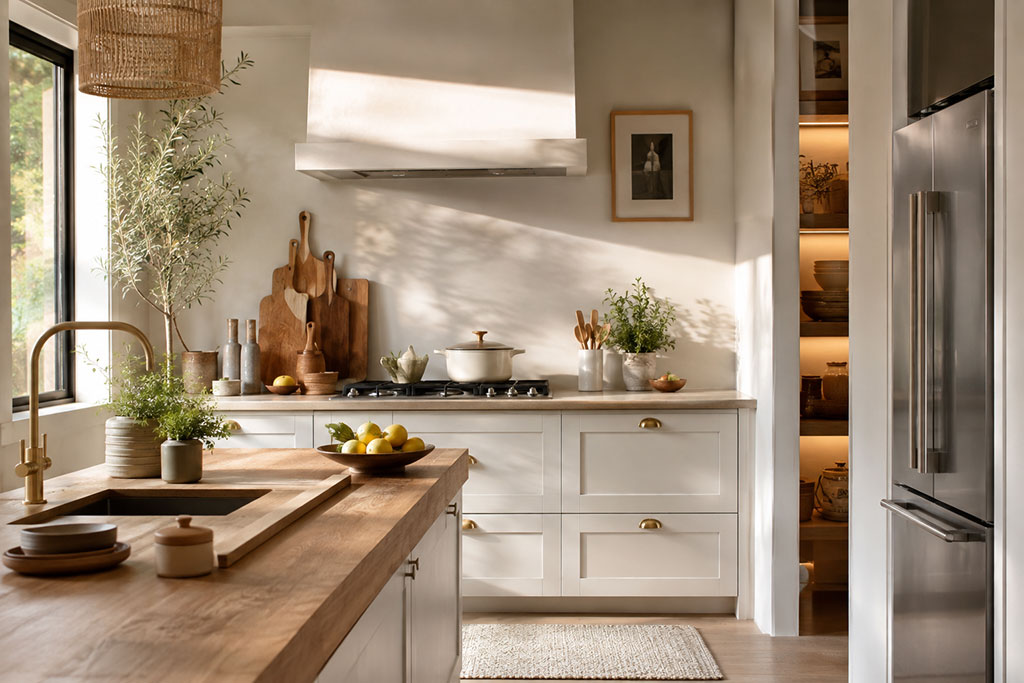
Whenever possible, separate them with Wood energy. In the cycle of the Five Transformations, Wood bridges Water and Fire. You can achieve this separation through material, colour or a decorative element, such as a wooden countertop or plants placed between the two points.
When Fire and Water Face Each Other
Facing each other is a different story. In that configuration, the two elements can symbolically recreate the balance between Li and Kan, representing life's two great energetic poles instead of direct confrontation, provided Qi circulates well in the space.
The goal is never to separate Water and Fire at all costs. It's to place them in a relationship of balance.
Light, Air and Cleanliness: The Kitchen's Foundation
As the most Yang room in the house, the kitchen needs lively, active, bright energy for food preparation to happen under good conditions.
Natural Light and Ventilation
Favour natural light whenever possible. When that isn't feasible, invest in good quality artificial lighting, evenly distributed across the work area.
A dark kitchen reduces exactly the Yang this room needs most.
Ventilation matters just as much. Opening the window regularly renews the air, reduces humidity and eliminates odours.
Even with a good extractor fan, natural ventilation remains one of the most effective ways to revitalise the kitchen's Qi, since heat and humidity build up there daily.
Avoid Exposed Beams and Low Ceilings
Avoid exposed beams directly above the stove or the cook, whenever possible. The same goes for excessively low ceilings in that area.
Both tend to convey pressure and compression exactly where you need movement, vitality and good Qi circulation.
Cleanliness Equals Circulating Qi
Cleanliness and organisation might be the simplest principle of all. Food represents one of the most concentrated forms of Qi, since it enters the body daily through what we eat.
A clean, tidy kitchen favours more harmonious food preparation. A build up of clutter, waste or unused utensils tends to block the free circulation of energy.
What Your Fridge and Pantry Say About You
In Traditional Feng Shui, the fridge, pantry and food cupboards symbolically represent the family's reserves.
An empty fridge, a disorganised pantry, or forgotten out of date food can convey an energy of scarcity, waste or stagnation.
Keeping these areas clean, organised and reasonably well stocked is a symbolic way of caring for the home's abundance and security.
This doesn't mean hoarding for the sake of it. Prosperity isn't accumulation. It's the ability to keep resources available, useful and in circulation.
The Trash Bin's Hidden Energy (Jue Ming)
The rubbish bin deserves the opposite kind of care. It's symbolically associated with Jue Ming energy (絕命), linked to decline, loss and disruption.
Keep it covered, and empty it regularly. Leaving it uncovered or letting it pile up favours a less harmonious atmosphere in one of the home's most important rooms.
Small Details With Big Symbolic Weight
Some of the best known kitchen rules in Feng Shui might look like minor details at first glance. But each one carries its own energetic logic.
Exposed Knives and Sha Qi
Exposed knives represent cutting Qi, known as Sha Qi. Left out on the counter, they introduce more aggressive energy into a room tied to the family's health and wellbeing.
Whenever possible, store them in a drawer, a proper knife block or another safe place.
Mirrors Behind the Stove
A mirror behind the stove can symbolically reinforce prosperity, but only when the stove is correctly oriented.
When the orientation is auspicious, the mirror symbolically doubles the energy of the food, reinforcing the family's health and abundance. If the orientation is unfavourable, the mirror doubles that unfavourable energy instead.
As we've covered in another article about mirrors, the secret is never just using the "cure." It's knowing whether the conditions are right in the first place.
Stove Type, Herbs and Colours
The type of stove factors into the analysis too. Charcoal, wood, gas, electricity and induction represent different manifestations of Fire energy, more Yin or more Yang depending on the system.
Even the aromatic herbs in your kitchen, basil, rosemary, mint, have their own classification within the Five Transformations. The most favourable choice depends on the kitchen's sector and energy map.
The colours in your cupboards, countertop or tiles can be read through the same lens. They reinforce or unbalance the energy of the sector where the kitchen sits.
None of these details alone determines a kitchen's Feng Shui. Together, they're all part of the same analysis.
Even Meals Have Their Place in Feng Shui
In Traditional Feng Shui, breakfast is the most Yang meal of the day, the moment the body wakes up and prepares for activity. The kitchen, being the most Yang room in the house, is perfectly in tune with that energy.
Dinner is the most Yin meal. The body starts slowing down and preparing for rest. Whenever possible, reserve it for a calmer, cosier setting, such as the dining room, to favour a smoother transition into the night.
What About Open-Plan Kitchens?
Contemporary kitchens increasingly integrate into the living room, with no walls separating the two spaces. This layout encourages togetherness and conversation.
But it brings an interesting energetic challenge. Since the kitchen is a strongly Yang space, its energy spreads more easily throughout the whole social area.
In these layouts, the island, the stove, the table, the circulation paths and the Flying Stars chart become even more relevant than in an enclosed kitchen.
The goal isn't to prevent this openness. It's to make sure the kitchen integrates energetically with the living room, instead of dominating the whole space.
The 5 Most Common Kitchen Feng Shui Mistakes
Bringing together the most important principles, here are the mistakes that most often compromise a kitchen's energy:
- Stove and sink side by side, with no separating element. Creates a direct confrontation between Fire and Water.
- Cooking with your back to the door. Removes the sense of control and security tied to the commanding position.
- Knives always left out on the counter. Introduces Sha Qi, cutting energy, into a room linked to the family's health.
- An uncovered or overflowing bin. Reinforces an energy of decline and stagnation in a central space of the home.
- Insufficient light and ventilation. Reduces the Yang the kitchen needs to prepare food under good conditions.
Where to Start: 4 Areas to Check First
Not every home lets you change the kitchen's location or the stove's orientation. But there's always somewhere to start. Before making any changes, look at these four areas:
- Location and orientation. Which sector is the kitchen in, and which direction does the stove face?
- Relationship between elements. Are the stove and sink in direct confrontation, or is there some balance between them?
- Light, air and cleanliness. Does the kitchen have enough brightness, ventilation and organisation to sustain its Yang nature?
- Small everyday symbols. What do the bin, the knives, the fridge and the pantry say? Do they reflect care or neglect?
These four points don't replace a full analysis of the home's energy map. But they're a solid starting point for spotting where your kitchen's energy might be losing strength.
Balance, Not Perfection: The Real Secret
Choosing a particular colour, adding an aromatic plant, moving the stove away from the sink or keeping the fridge full isn't enough on its own. None of these actions alone defines a kitchen's Feng Shui, and that isn't what Traditional Feng Shui asks of us.
The goal isn't a "perfect" kitchen. It's understanding where the biggest imbalances lie and correcting them mindfully, one detail at a time.
Being the most active and most Yang room in the house, the kitchen is also where small daily habits, light, cleanliness, organisation, have the most immediate effect on the energy of the entire home.
There's an even deeper reason to pay attention to it. Food is Qi. Every day, the kitchen prepares not only meals, but the very energy that nourishes the people you love most.
Caring for your kitchen's Feng Shui means caring for the health, vitality and prosperity of your whole family, long before the food reaches the table.
What about your kitchen? Is the stove well oriented? Is the bin emptied regularly? Are the knives kept out of sight? If you don't know your home's energy map yet, now's a good time to find out.
✨ Get in touch and schedule your Traditional Feng Shui consultation.
FAQ: Kitchens in Feng Shui
What is the best direction for a kitchen in Feng Shui?
The East and Southeast sectors are generally favourable, since Wood energy feeds the stove's Fire. The best direction always depends on your home's specific Flying Stars chart, not a generic rule.
Why shouldn't the stove be next to the sink in Feng Shui?
The stove represents Fire and the sink represents Water. Placed side by side, they create a direct energetic confrontation. Separating them with Wood energy, through material, colour or plants, restores balance.
Why should you keep knives out of sight in the kitchen?
Exposed knives represent Sha Qi, or cutting energy. Left out on the counter, they introduce a more aggressive energy into a room linked to the family's health and wellbeing.
Is it bad Feng Shui to have an open-plan kitchen?
Not necessarily. Open-plan kitchens just need extra attention to the island, the stove's orientation and the circulation paths, so the kitchen's strong Yang energy integrates well with the living room instead of overwhelming it.
What does a messy fridge mean in Feng Shui?
The fridge and pantry symbolically represent the family's reserves. An empty, disorganised or neglected fridge can convey an energy of scarcity or stagnation, while a clean, well stocked one supports abundance.