Living Room Feng Shui: Create a Home of Harmony
Is your living room helping your family connect, or quietly getting in the way? It is the most lived-in space in many homes: the place where the family gathers at the end of the day, where guests are welcomed, where children play and where lasting memories are made.
In Traditional Feng Shui, this centrality is not just emotional, it is also energetic. The living room holds a unique position among the rooms of a house and needs a very particular balance between Yin and Yang.
SUMMARY
- The living room must balance the calm of Yin with the vitality of Yang.
- Back the main sofa with a solid wall (the Turtle) and make sure you can see the door without being in line with it.
- Keep the center of the room (the Tai Ji) clear so Qi can circulate.
- Watch for beams, columns and sharp corners pointing at where you sit.
- Water, fire, plants, crystals and mirrors work best when placed according to your home's Flying Stars (Fei Xing) chart.
- Avoid the most common living room feng shui mistakes, listed below.
- Use the seven-point checklist at the end to start today.
Living room feng shui starts with Yin and Yang
Every room in the house has its own energetic nature. The bedroom favors Yin and supports rest. The kitchen and the home office lean toward Yang and promote activity.
The living room is where we rest, socialize, entertain and share. That means it must hold the calm of Yin and the vitality of Yang at the same time. Lighting, colors, furniture layout, the flow of Qi and the Flying Stars chart all work together to create that balance.
Location, orientation and your favorite seat
The sector of the house where the living room sits directly shapes its atmosphere. Each direction has its own qualities according to the Eight Trigrams and the Five Elements. Even so, a living room is not automatically favorable just because it faces North, South, East or West. Its true quality depends on the home's energy map, how the space is used and who lives there.
Pay special attention to the spot where you spend the most time, usually a favorite sofa or armchair. Whenever possible, its position and orientation should benefit from auspicious Qi. Take into account the Flying Stars chart, the characteristics of each sector and the occupants' favorable directions.
The main sofa: the Turtle and the commanding position
Your main sofa is where the family spends most of its time, so give it strong support.
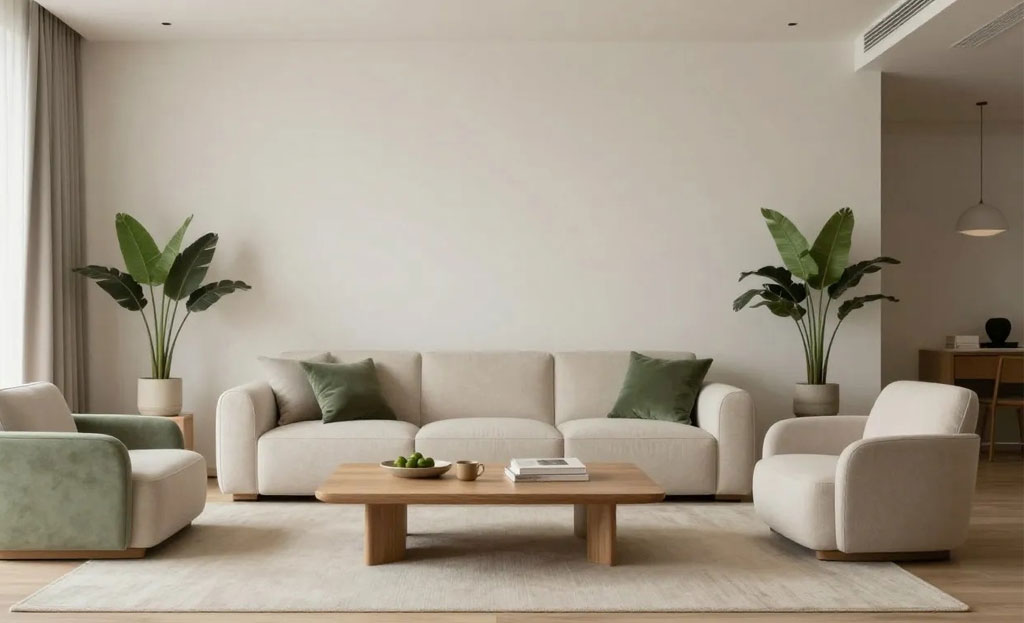
- Back it with a good Turtle. A solid wall behind the sofa conveys stability, protection and security.
- Avoid placing it in front of a window. If there is no alternative, a heavy curtain and a high-backed sofa help reinforce that protection symbolically.
- Take the commanding position. Whoever sits in the main spot should see the entrance door without being directly in line with it.
The commanding position brings a greater sense of control, security and calm. It also lets the Qi entering the room be received naturally, just as in the bedroom and the home office.
Keep the center open: the Tai Ji
At the center of the living room lies the Tai Ji, the point of balance from which Qi spreads through the space. When it fills up with furniture or objects, Qi flow is hindered and the room feels heavier. Keep the center as clear as possible so Qi can move between the different gathering areas.
The same balance applies to the whole room:
- Too crowded: Qi stagnates and the room feels heavy.
- Too empty: Qi moves too fast and the room is harder to make cozy.
Organization matters too. Give every object a function and a proper place, and keep only what genuinely adds value to the life of the people who live there.
The shape of the room and Cutting Qi
A living room benefits from a regular shape and a natural flow of Qi. These features can make the space less harmonious:
- Overly sharp angles
- Isolated columns and exposed beams
- Excessively low or sloped ceilings
- Hallways that discharge directly into the seating area
Look closely at the places where you sit most. A beam, a column or the sharp corner of a piece of furniture pointing at your sofa or armchair can create pressure, known as Cutting Qi. Reposition the furniture, soften the edges or choose a more sheltered seat.
Size the coffee table in proportion to the seating area, with enough room to move comfortably between sofas and chairs. Letting Qi flow and people move without obstacles matters more than filling the center.
The Five Elements in your living room
Colors, shapes and materials are not only an aesthetic choice. Within the Five Elements, each one contributes differently to the Qi of the room.
Earth: stability and balance
Earth shows up in ceramics, natural stone, terracotta, porcelain, crystals and square shapes. It represents the center, stability and balance, and it is especially useful for harmonizing Yin and Yang. Crystals, chosen and placed according to the sector and the Flying Stars chart, can help stabilize the room's energy.
Water, fire and wood: activate with care
- Moving water is one of the most powerful Qi activators, and one of the most delicate. In the right sector it can boost prosperity and vitality. In the wrong sector it can activate challenging energies.
- The fireplace is a strong expression of Fire. It strengthens Qi only when installed in a favorable sector.
- Plants carry Wood energy. They revitalize the environment and help soften the Sha Qi produced by electrical equipment.
The rug and the clock
- The rug gathers and anchors the Qi of the seating area, symbolically defining the space of the sofa and coffee table.
- The clock symbolizes the continuous movement of time. Keep it running, and avoid stopped or broken clocks, which symbolize stagnation.
In every case, choose shape, color and material according to the room's Flying Stars (Fei Xing) chart.
Mirrors: what are they duplicating?
Mirrors can visually enlarge the living room and reflect Qi, but what they reflect matters most. A pleasant view, an attractive area or a favorable image can be enhanced by a mirror. There is no benefit in duplicating clutter, Sha shapes or other unfavorable elements. Place mirrors according to the sector and your home's Flying Stars chart.
The television and the Yang balance
Few objects are as Yang as the television. Even switched off, it keeps dominating the space visually. Electronic equipment also tends to generate positive ions, often associated in Feng Shui with a form of Sha Qi.
Natural plants and soft ambient lighting help balance this energy. They keep the room from revolving around the screen and support conversation, rest and a harmonious flow of Qi.
Sound and scent: harmonizing the senses
Traditional Feng Shui also engages the senses. Sound directly influences the quality of Qi, and music can quickly transform a room, making it more Yin for rest or more Yang for socializing and celebration. That is why the living room is one of the best places in the home for a good sound system.
Musical styles can be classified by the Five Elements, just like colors and materials. The most harmonious music depends on the moment, the room's sector and its Flying Stars chart.
Scent works the same way. Each fragrance has an energetic nature linked to one of the Five Elements, so choosing one should not rely on personal preference alone. In harmony with the sector and the home's Flying Stars chart, the right scent reinforces comfort, balance and well-being for the whole family.
Photos, art and symbolic imagery
The living room also holds the more human side of the home.
- Family photographs: Display happy images that convey harmony, smiles and good memories. They symbolically strengthen family bonds. Whenever possible, keep bedrooms for a more intimate energy, without these photographs.
- Artwork: Choose art that reflects who you are, your values and what you wish to attract into your life. It should spark positive emotions and create a welcoming atmosphere for family and visitors.
- Spiritual or inspiring pieces: An image of the Buddha or another symbol in keeping with the family's beliefs can reinforce peace, serenity and unity, provided it sits in an auspicious sector according to the Flying Stars chart.
As with the other elements, the choice of imagery can be harmonized with the room's sector and Flying Stars chart.
A room ready to welcome
The living room is the home's main social space. Prepare it for family and guests with enough seating, comfortable circulation and a layout that encourages conversation.
Sofas and chairs placed too far apart, blocked by furniture or all facing only the television weaken this gathering function. The room does not need to be full of people all the time, but it should feel ready to welcome. When the space invites people to sit, talk and linger, it reinforces the Yang, social side of the room without losing the Yin comfort needed for rest.
Pets as readers of Qi
Pets are part of your home's energy too. They spend many hours resting in the living room, and the spot they choose can reveal something about the Qi of that sector:
- Cats tend to seek areas with calmer, more Yin Qi.
- Dogs often prefer more active, more Yang areas.
Notice where your pet likes to settle. It offers interesting clues about the energetic nature of the different sectors of the room, and of the home itself.
The most common feng shui living room mistakes
- Placing the main sofa without solid support behind it. A window or a walkway at its back weakens the sense of protection and stability.
- Not being able to see the door from the main seat. The commanding position helps the room receive Qi with greater security and calm.
- Blocking the center and its circulation. Too much furniture, an oversized coffee table or obstacles in the walkways make the Qi heavier.
- Letting the television dominate the whole room. The room should also support conversation, rest and connection.
- Ignoring beams, columns and Cutting Qi. Edges or structural elements pointing at seating areas can create pressure on the people sitting there.
- Placing water features, fireplaces, plants, crystals or other activators for looks alone. Their placement should be compatible with the sector and the Flying Stars chart.
- Hanging a mirror without considering what it reflects. A mirror can duplicate a favorable feature just as easily as an unwanted one.
- Creating a room that does not invite people in. The seating layout should make conversation, movement and togetherness easy.
Where to start: a 7-point living room checklist
You cannot always change the shape or location of a living room, but there is always somewhere to begin. Before making changes, review these seven points:
- The main sofa. Does it have a solid wall behind it? Can you see the door without being directly in line with it?
- The center and its circulation. Is the Tai Ji relatively clear? Can you move naturally between the seating areas?
- The room's interior form. Are there beams, columns, low ceilings, sharp angles or furniture corners pointing at the spots where you spend the most time?
- The seating area. Is the coffee table proportional? Do the sofas and chairs encourage conversation and gathering?
- The elements and activators. Are water features, the fireplace, plants, crystals, rugs, clocks and mirrors placed according to the sector and the energy map?
- The Yin-Yang balance. Does the television avoid dominating the space? Do lighting, sound and scent let the room adapt to both rest and socializing?
- The social function. Is the room organized and ready to welcome family and guests comfortably?
These points do not replace a full analysis of your home's energy map. They do help reveal whether your living room is supporting the flow of Qi, family connection and harmony.
FAQ: Living room feng shui
Where should the main sofa go in a feng shui living room?
Place it with a solid wall behind it, the Turtle, which conveys stability, protection and security. Avoid putting it directly in front of a window. If you have no alternative, use a heavy curtain and a high-backed sofa.
What is the commanding position in the living room?
It is the main seat from which you can see the entrance door without being directly in line with it. This gives a greater sense of control, security and calm, and lets the Qi entering the room be received naturally.
Should the center of the living room be empty?
Keep it as clear as possible. The center is the Tai Ji, the point from which Qi spreads through the space. A cluttered center hinders Qi and makes the room feel heavier, while a room that is too empty lets Qi move too fast.
Can I put a mirror in the living room?
Yes, but what it reflects matters most. A mirror can enhance a pleasant view or an attractive area. Avoid duplicating clutter or Sha shapes, and place it according to your home's sector and Flying Stars chart.
Is a television bad for living room feng shui?
The television is a very Yang object and keeps dominating the space even when switched off. Balance it with natural plants and soft ambient lighting, and arrange the seating so the room supports conversation and not only the screen.
Is a living room in a certain direction always favorable?
No. Each direction has its own qualities, but a room is not automatically favorable because it faces North, South, East or West. The true quality of a sector depends on the home's energy map, how the space is used and the people who live there.
A space that brings the family together
More than sofas and decor, the living room is where conversations happen, where we rest, celebrate and play. In Traditional Feng Shui, the balance between Yin and Yang decides whether it truly supports communication, togetherness and the well-being of the whole family. That balance is built through location, furniture layout, colors, the Five Elements and the Flying Stars chart.
So ask yourself: is your living room truly working in favor of your family's harmony?
Get in touch and schedule your Traditional Feng Shui consultation.